
The Finance Minister has opened the door to a debate on LTCG and STT. Here is the data on how these two taxes grew, what they collect, how FIIs have behaved — and what their removal could realistically do for Indian equities.
LTCG and STT: Can Scrapping Them Give Indian Equities a Fresh Start — and Bring FIIs Back?
By Rohit Jain Bhansali, Rubicon Finservices | 14 October 2026
On Tuesday, 13 October 2026, at the Bloomberg New Economy Forum in New Delhi, Finance Minister Nirmala Sitharaman was asked the question every equity investor has been asking this year: will the government scrap Long-Term Capital Gains (LTCG) tax?
She did not say yes. But she did not shut the door either. She said the government would be keen to hear views on removing LTCG during Budget consultations, called the debate around Securities Transaction Tax (STT) and the taxation of different asset classes "healthy", and acknowledged the argument that the two taxes overlap. She also added that with Budget preparations already underway, it was not the right time to say what she would or would not consider.
That is a meaningful shift in tone. Only in July 2026, the Ministry told the Lok Sabha that there was no proposal to scrap LTCG on equities. Markets noticed — Sensex and Nifty extended their gains after the remark.
So what exactly are these two taxes, how did we get here, and would removing them really bring foreign investors back? Let's go through the data.
1. How we got here: a 22-year timeline
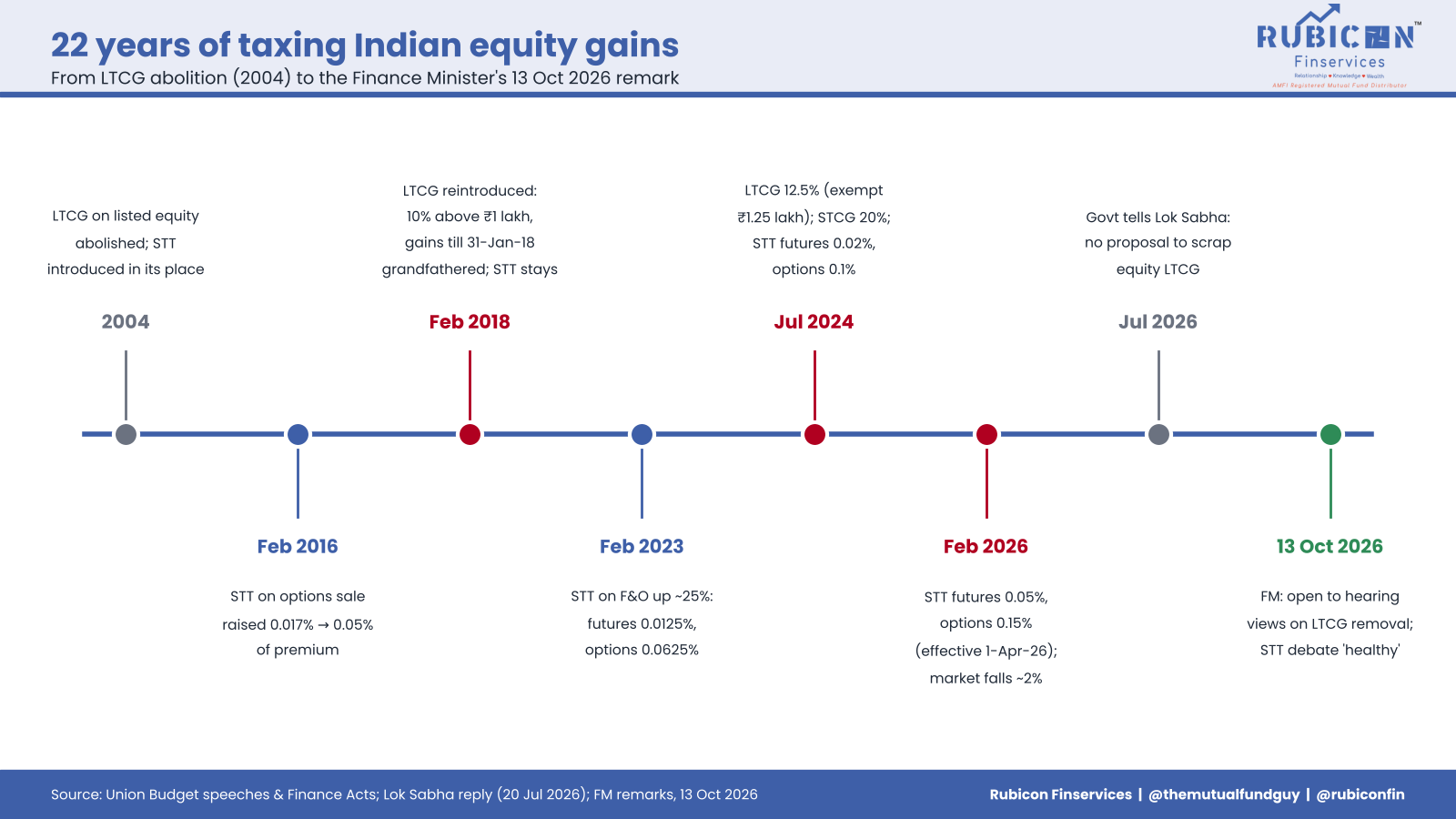
The story starts in 2004, when long-term gains on listed shares were made tax-free and STT was introduced in its place. The logic was simple: instead of chasing capital gains, collect a small tax on every trade at the exchange. One tax, collected at source, hard to evade.
That bargain held for 14 years. Then, in the February 2018 Budget, the current government brought LTCG back — 10% on gains above ₹1 lakh a year, with gains up to 31 January 2018 grandfathered. Crucially, STT was not removed. From that day, an Indian equity investor has paid both: a tax on the transaction and a tax on the gain.
Since then, every change has gone in one direction:
- Budget 2016: STT on options sales raised from 0.017% to 0.05% of premium.
- Budget 2023: STT on futures and options raised by about 25%.
- Budget July 2024: LTCG raised to 12.5% (exemption raised to ₹1.25 lakh), STCG raised from 15% to 20%, and STT on F&O roughly doubled.
- Budget February 2026: STT on futures raised to 0.05% and on options to 0.15%, effective 1 April 2026. Sensex and Nifty fell nearly 2% on Budget day — their worst Budget-day fall in six years.
2. LTCG and STCG: three regimes, one direction
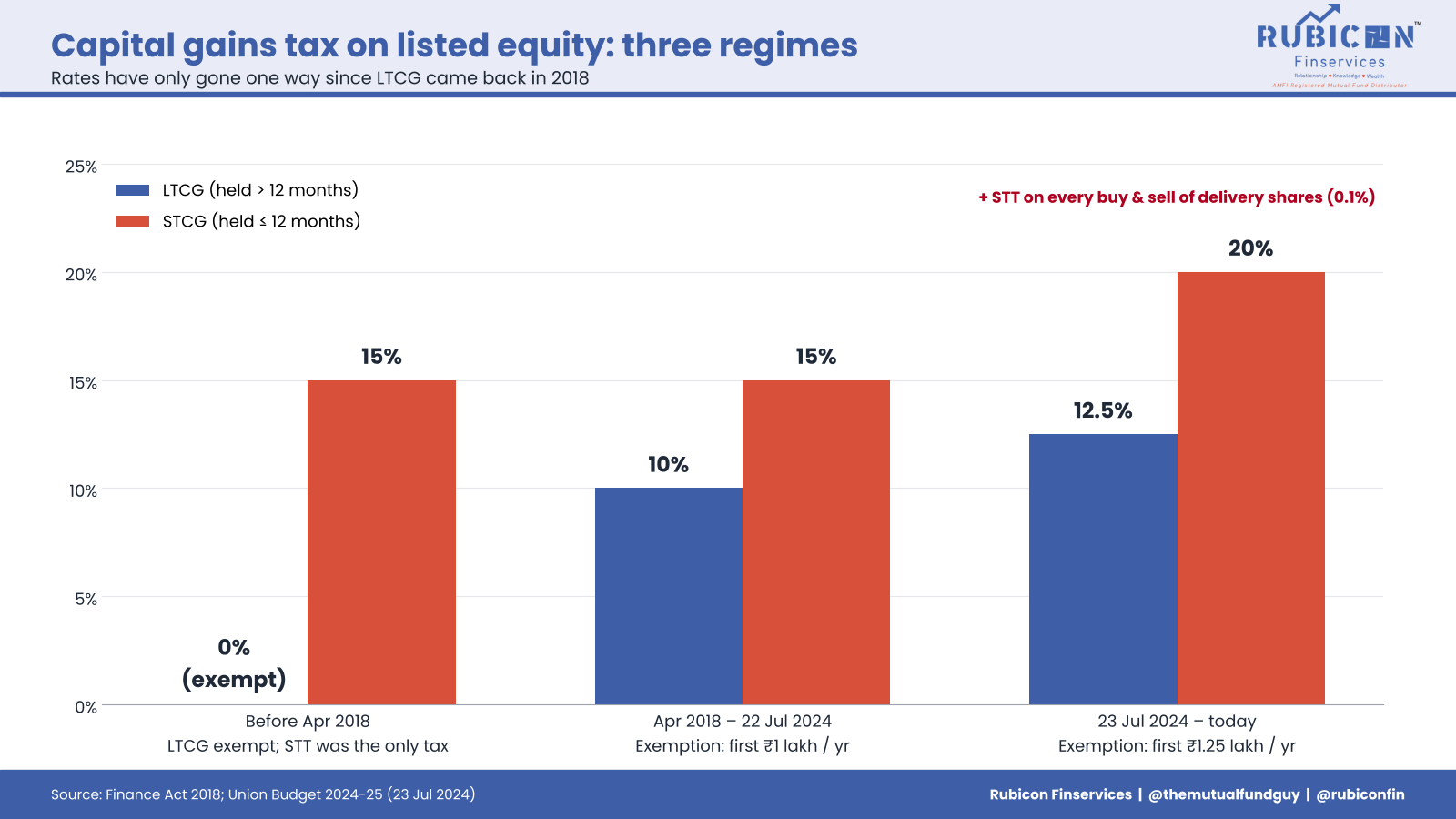
A long-term equity investor went from paying zero on gains to 10%, and now 12.5%. A short-term investor went from 15% to 20%. And over all three regimes, STT on delivery trades (0.1% on both buy and sell) has stayed in place.
3. STT on derivatives: up 5x and 3x
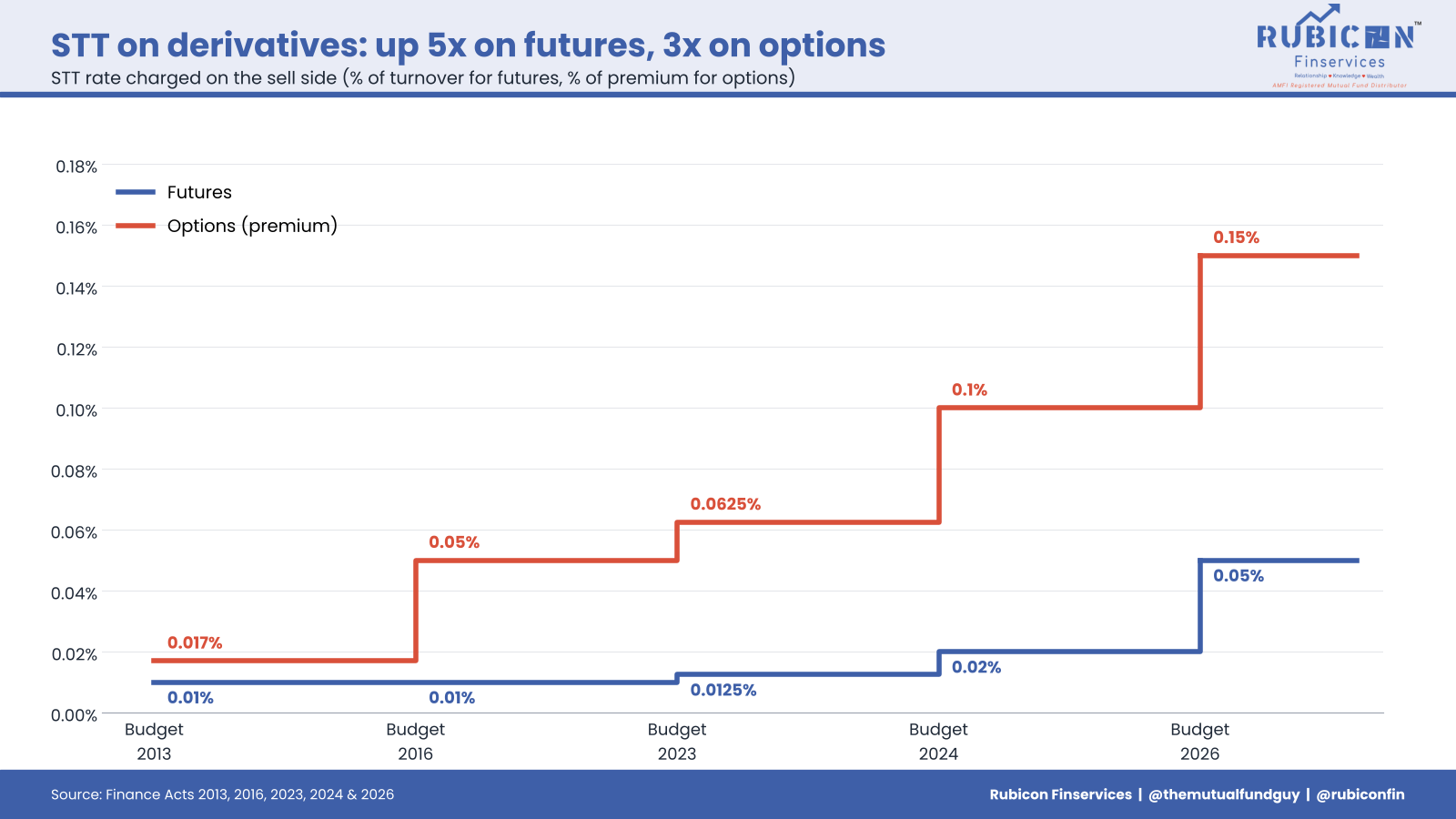
STT on futures has gone from 0.01% (2013) to 0.05% today — five times. On options premium it has gone from 0.05% (2016) to 0.15% — three times. The stated aim is to cool excessive retail speculation in F&O, and that aim is legitimate. But these hikes also raise costs for hedgers, arbitrage funds and the liquidity providers that make a market deep — exactly the participants foreign institutions rely on.
4. What the government collects
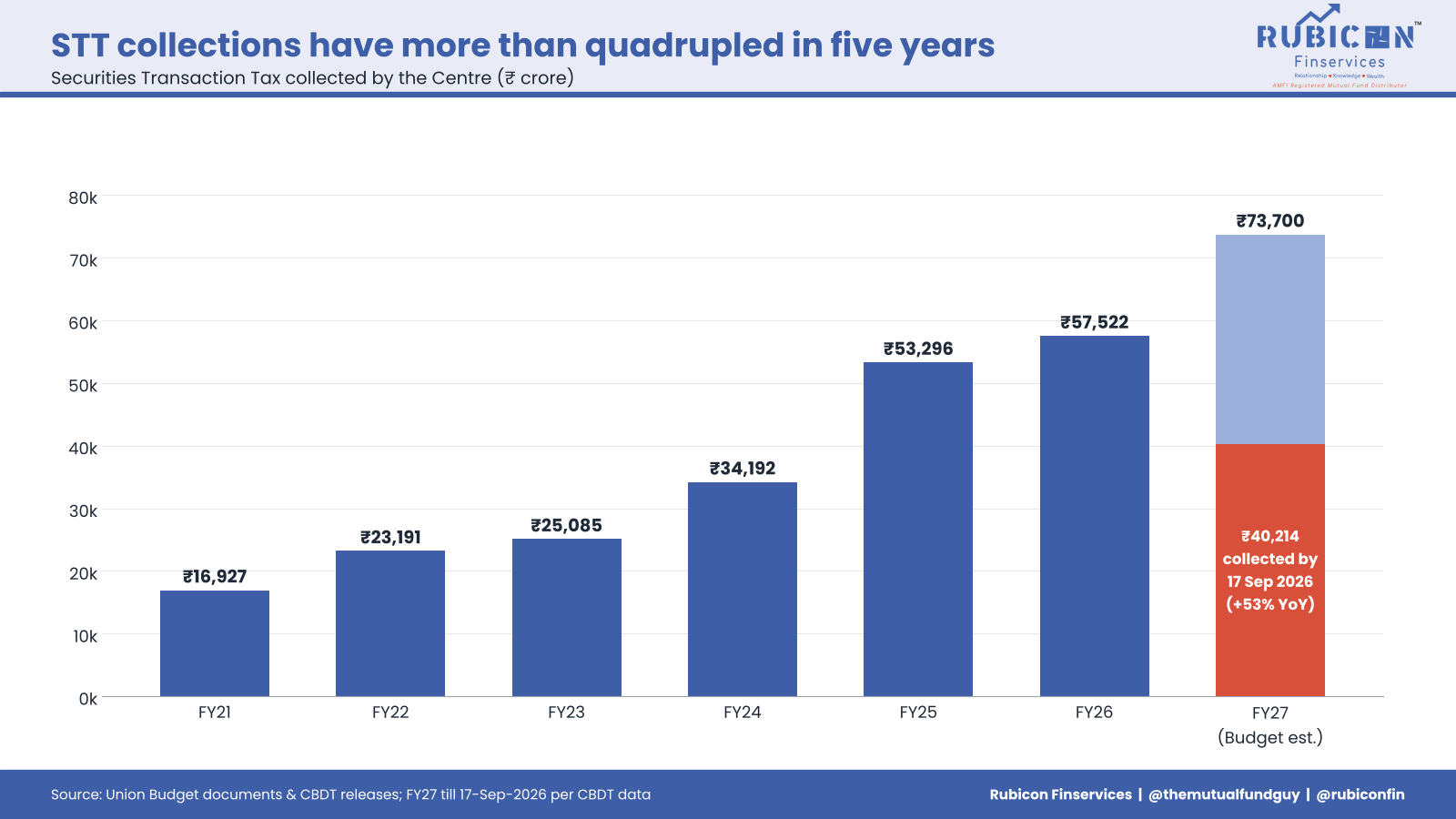
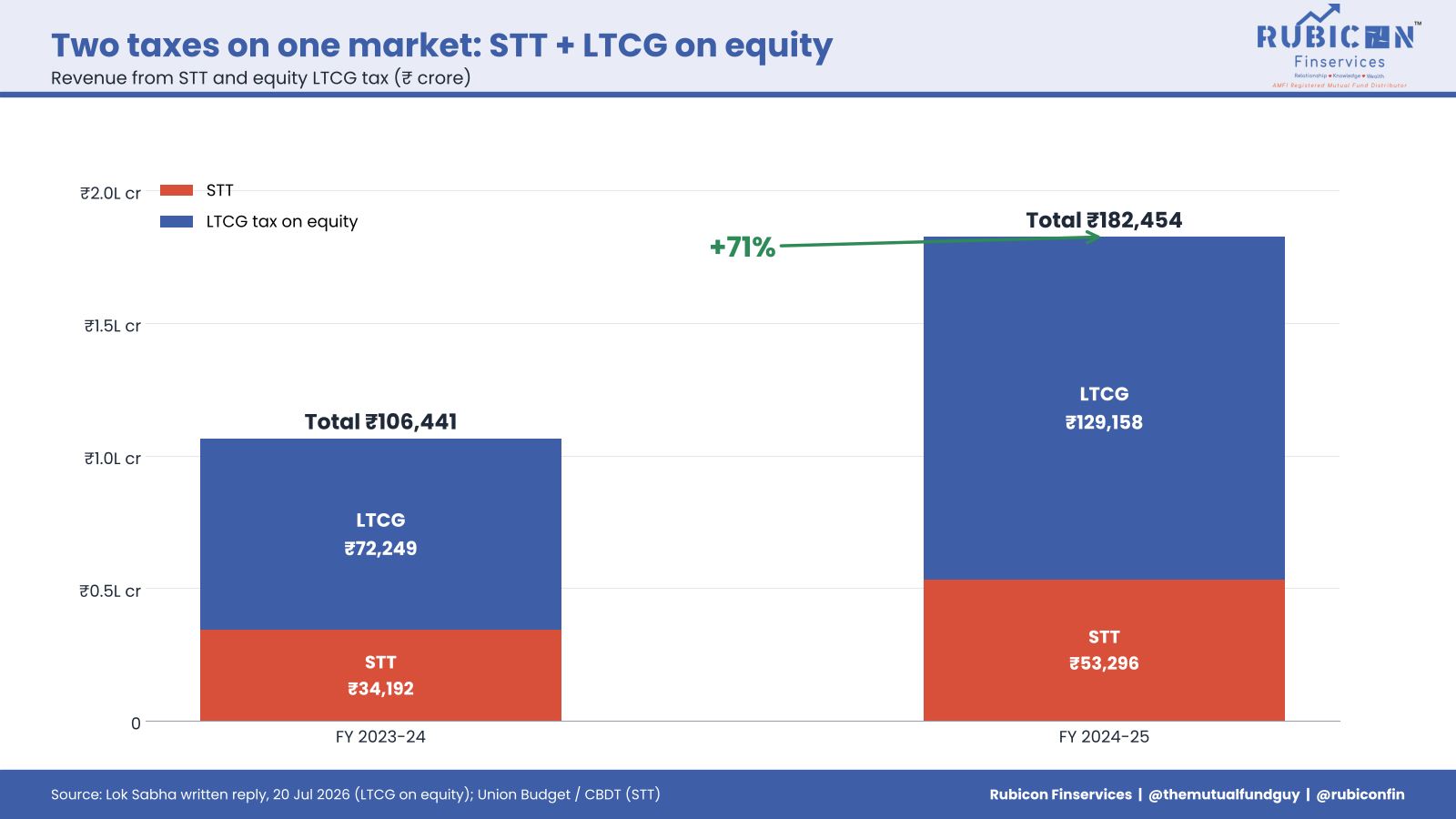
STT has gone from about ₹16,900 crore in FY21 to ₹57,522 crore in FY26, and the Budget estimate for FY27 is ₹73,700 crore. With the new rates, ₹40,214 crore had already been collected by 17 September 2026 — 53% higher than a year earlier.
LTCG on equity is now the bigger of the two. According to the Finance Ministry's reply in Parliament, equity LTCG brought in ₹72,249 crore for FY 2023-24 and ₹1,29,158 crore for FY 2024-25. Together with STT, the equity market contributed about ₹1.82 lakh crore in FY25 through these two taxes alone — up 71% in a single year.
This is the honest obstacle to removal. Equity LTCG alone was roughly 5.8% of the Centre's net direct tax collection in FY25 (₹22.26 lakh crore). No Finance Minister gives that up lightly, especially while promising fiscal prudence — which she repeated in the same speech.
5. The turbulence: why this debate is happening now
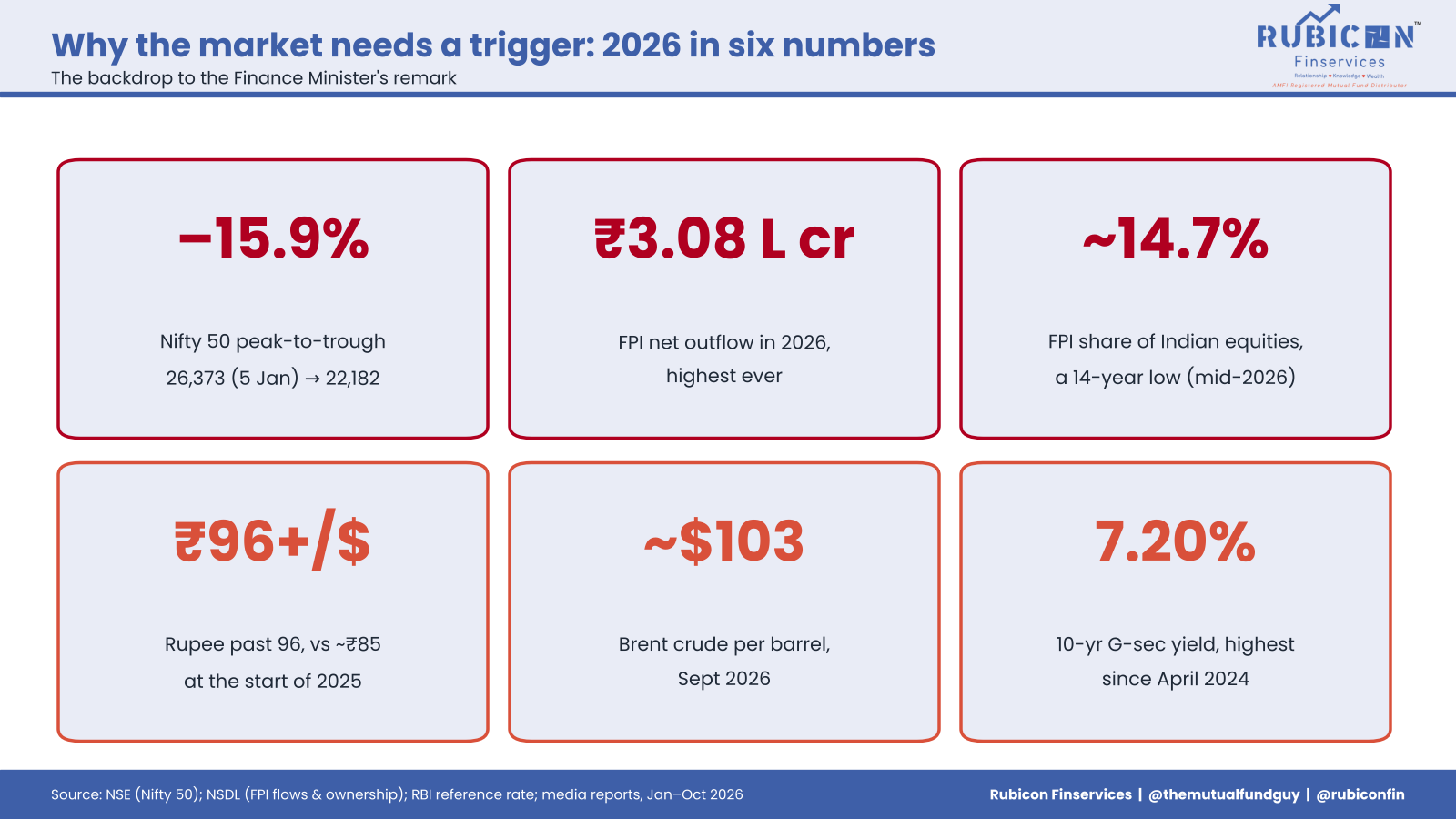
2026 has been a hard year. The Nifty 50 fell about 16% from its January peak of 26,373 to a low of 22,182. Brent crude has been around $103, the rupee has weakened past 96 to the dollar, and the 10-year G-sec yield touched 7.20%. The September derivatives series alone ended about 5.7% lower.
Above all, foreign investors have been leaving at a record pace.
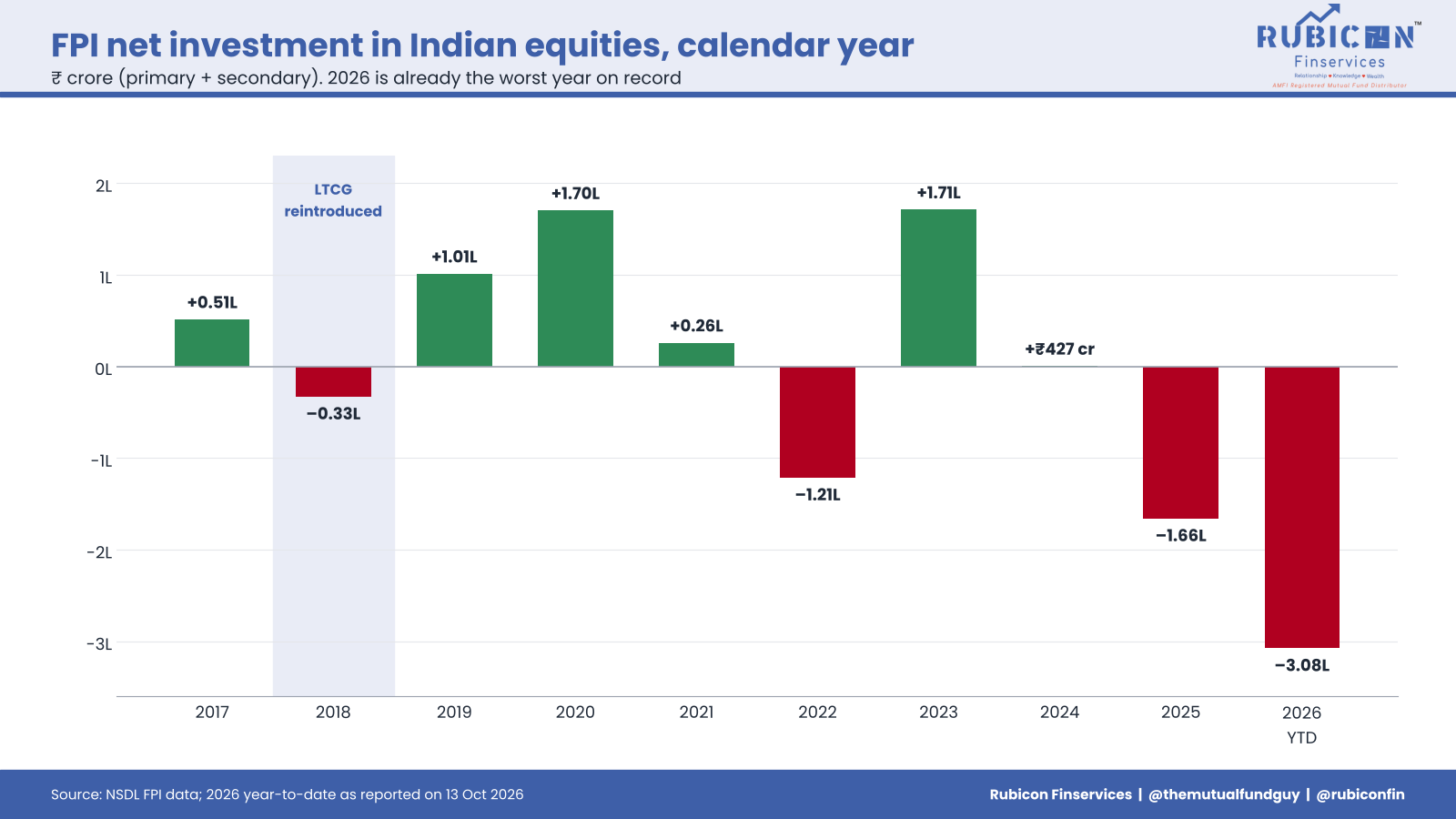
FPIs have pulled out ₹3,07,719 crore in 2026 so far — on top of ₹1.66 lakh crore in 2025. Their share of Indian equities slipped to around 14.7% by mid-2026, a 14-year low. The only bright patch was July and August, when FPIs bought ₹20,200 crore and ₹29,630 crore — before turning sellers again with ₹35,861 crore of outflows in September.
What has held the market up is the Indian investor. Domestic institutions — fuelled by record SIP inflows — have absorbed most of the foreign selling. That is a remarkable change from a decade ago.
6. Will removing LTCG and STT bring FIIs back?
This is the real question. The data gives a nuanced answer.
India taxes twice where peers tax once, or not at all.
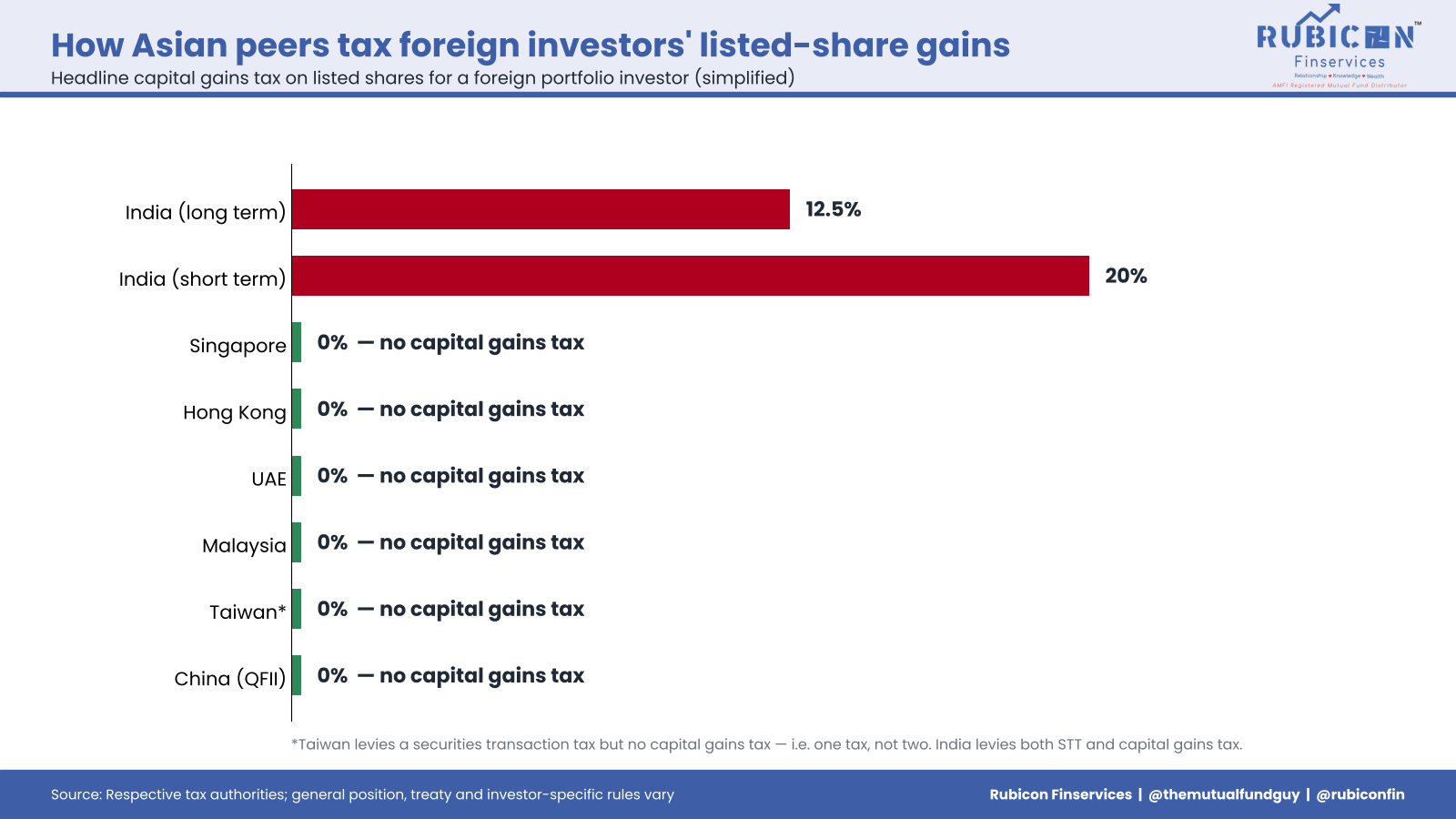
Most Asian markets that compete with India for the same emerging-market dollar — Singapore, Hong Kong, the UAE, Malaysia — do not tax a foreign investor's gains on listed shares. Taiwan has a transaction tax but no capital gains tax: one tax, not two. India levies 12.5% LTCG, 20% STCG and STT. Since the Mauritius and Singapore treaty changes of 2016-17, most FPIs can no longer route around Indian capital gains tax either.
- The government has already accepted the logic — for bonds. Earlier this year, an ordinance exempted FPIs from LTCG on government securities from 1 April 2026, specifically to support the rupee and revive foreign flows. Extending a similar principle to equities is not a leap; it is the next step.
- A post-tax return problem. An FPI who bought Nifty stocks at ₹84 to the dollar and sold at ₹95 lost roughly 12% on the currency alone. When the rupee is already eating returns, a 12.5–20% tax on whatever gain is left makes India look expensive next to markets that charge nothing.
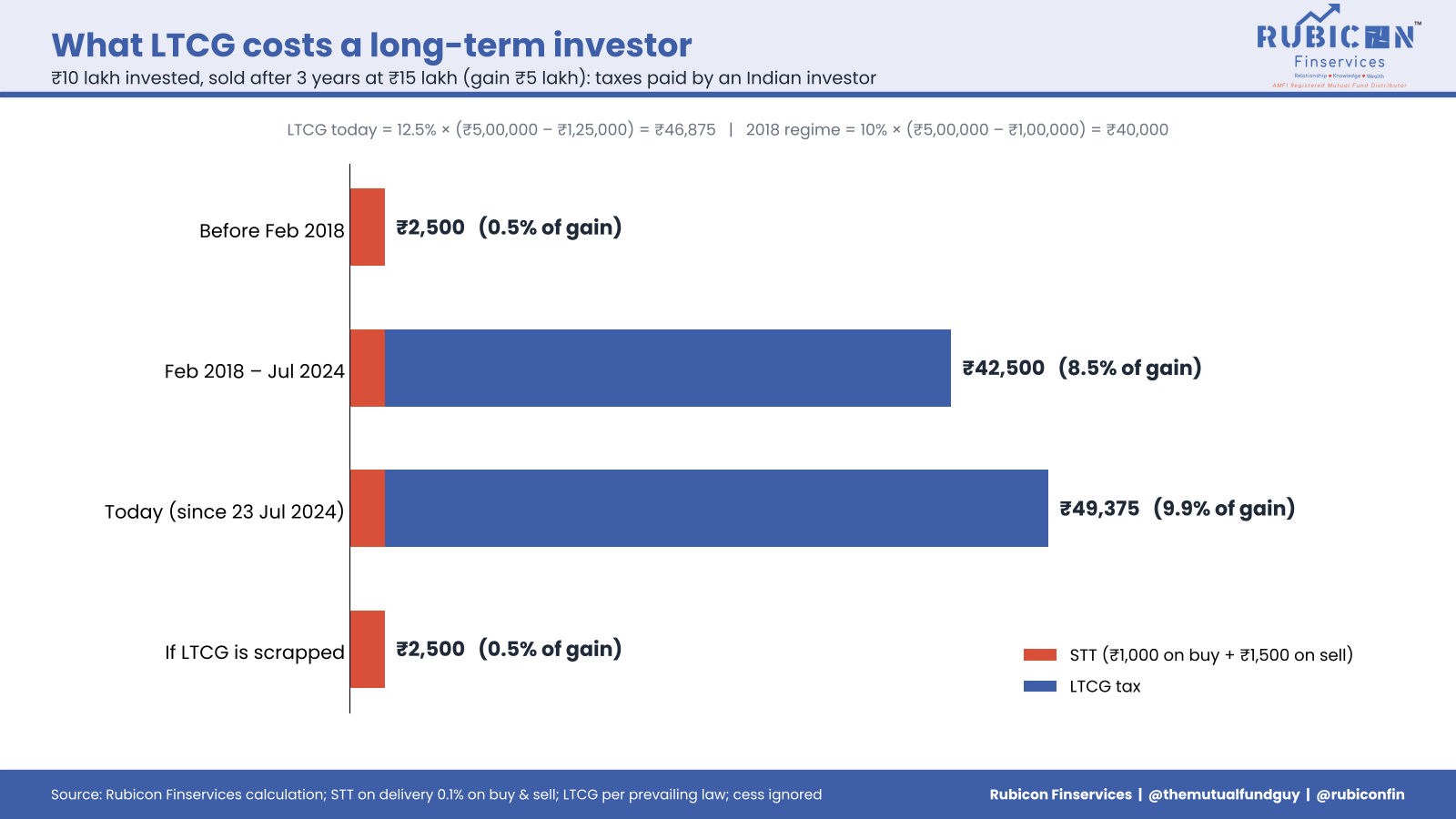
- For Indian investors, the difference is real money. On ₹10 lakh invested and sold at ₹15 lakh after three years, an investor paid just ₹2,500 (STT) before 2018. Today the same investor pays ₹49,375 — nearly 10% of the gain. Scrapping LTCG takes that back to ₹2,500.
The case for caution
- 1Tax was not what drove FIIs away — and it won't alone bring them back. Look at chart 7 . When LTCG returned in 2018, FPIs sold ₹33,000 crore that year — and then bought ₹1.01 lakh crore in 2019 and ₹1.70 lakh crore in 2020, with LTCG fully in place. 2023 saw ₹1.71 lakh crore of buying at the same tax rates. Foreign money moves on the rupee, US bond yields, crude, earnings growth and valuations. The 2026 sell-off is driven by those factors far more than by tax.
- 2The fiscal cost is large Giving up ₹1.3 lakh crore or more a year when crude is above $100 and the rupee is under pressure is a serious trade-off.
- 3F&O STT has a policy purpose. The derivative STT hikes were meant to protect retail traders from heavy losses. A full rollback there is unlikely, and arguably shouldn't happen.
The realistic middle path
Watch for one of these in Budget 2027-28 (expected 1 February 2027):
- Keep one tax, not two — the "overlap" argument the FM herself acknowledged. Removing LTCG while retaining STT would return India to the 2004 design.
- Zero LTCG with a longer holding period — SBI Research has proposed scrapping equity LTCG while extending the holding period to two to three years, rewarding patient capital rather than all trading.
- A higher exemption limit than ₹1.25 lakh, if full removal is too costly.
- Relief on delivery STT while leaving the derivatives STT intact.
The bottom line
Removing LTCG — or even one of the two overlapping taxes — would be the strongest pro-equity signal since 2004. It would improve India's post-tax competitiveness against its Asian peers, reward long-term investing, and could act as a sentiment trigger in a market that badly needs one. Tuesday's rally shows how much the market wants to believe it.
But it is a necessary-not-sufficient reform. FIIs will come back in size when the rupee stabilises, crude cools, US yields ease and earnings growth returns. Tax relief makes India more attractive when that happens; it does not by itself make it happen.
Rohit Jain Bhansali,Founder,Rubicon Finservices
rjb@rubiconfinservices.com
- What should you do as an investor? Nothing dramatic. A statement of openness is not a policy. Until the Finance Bill says otherwise, 12.5% LTCG and the ₹1.25 lakh exemption remain. Keep your SIPs running — the domestic investor is the reason this market has held up in a ₹3 lakh crore FII exodus. Use your ₹1.25 lakh annual LTCG exemption every year (tax-gain harvesting) and don't postpone sensible rebalancing hoping for a Budget announcement that may or may not come.
ARN 102867 | Initial Registration 09-June-2015 | Valid till 01-07-2027 | SIF Valid till 15-03-2029 | APRN Valid till 17-10-2027 | APMI: APMI-APRN01145 | MSME: UDYAM-WB-14-0192124 | Grievance Officer: Prem Prakash Bhansali, complaints@rubiconfinservices.com
Mutual Fund and Specialised Investment Fund investments are subject to market risks; read all scheme and investment strategy related documents carefully before investing. SIF investments carry higher risk, including the use of derivatives and short positions, and require a minimum investment of ₹10 lakh per PAN. Past performance is not indicative of future returns. Rubicon Finservices is an AMFI-registered Mutual Fund Distributor and receives commission from Asset Management Companies for the schemes and strategies it distributes. This article is for investor education only and is not investment advice or a recommendation of any specific scheme or strategy. Figures in the illustrations are indicative.