
When an asset is in the news, everyone wants in, usually near the top. Using the 2025–26 silver frenzy and the 2020 stock market crash, this blog explains why following the crowd leads to buying high and selling low, and how asset allocation, rebalancing and steady SIPs help you do the opposite.
Herd Mentality in Investing: Why Following the Crowd Costs You Money
"My colleague made 40% in silver. My neighbour just bought gold. My cousin says small caps only go up."
Everyone is buying. Should you? Lessons from the gold, silver and stock market cycles, and what disciplined investors do differently.
If you have ever felt the urge to invest in something simply because everyone around you was doing it, you have experienced herd mentality. It is one of the oldest and most expensive habits in investing. It does not come from a lack of intelligence. It comes from being human.
What is herd mentality in investing?
Herd mentality is the tendency to copy what the majority is doing instead of making an independent decision. In markets, it usually shows up in three forms:
- FOMO (fear of missing out): An asset has already risen sharply, everyone is talking about it, and you feel you will be left behind if you don't buy now.
- Social proof: "So many people can't all be wrong." Crowds feel safe, even when they are heading the wrong way.
- Recency bias: We assume whatever happened in the last few months will continue. Recent winners look like permanent winners, and recent losers look like permanent losers.
The problem is simple. By the time an investment becomes the talk of the town, a large part of the gains has usually already happened. The crowd tends to arrive late, and when the trend reverses, it also tends to leave in a hurry.
Case study 1: The silver frenzy of 2025–26
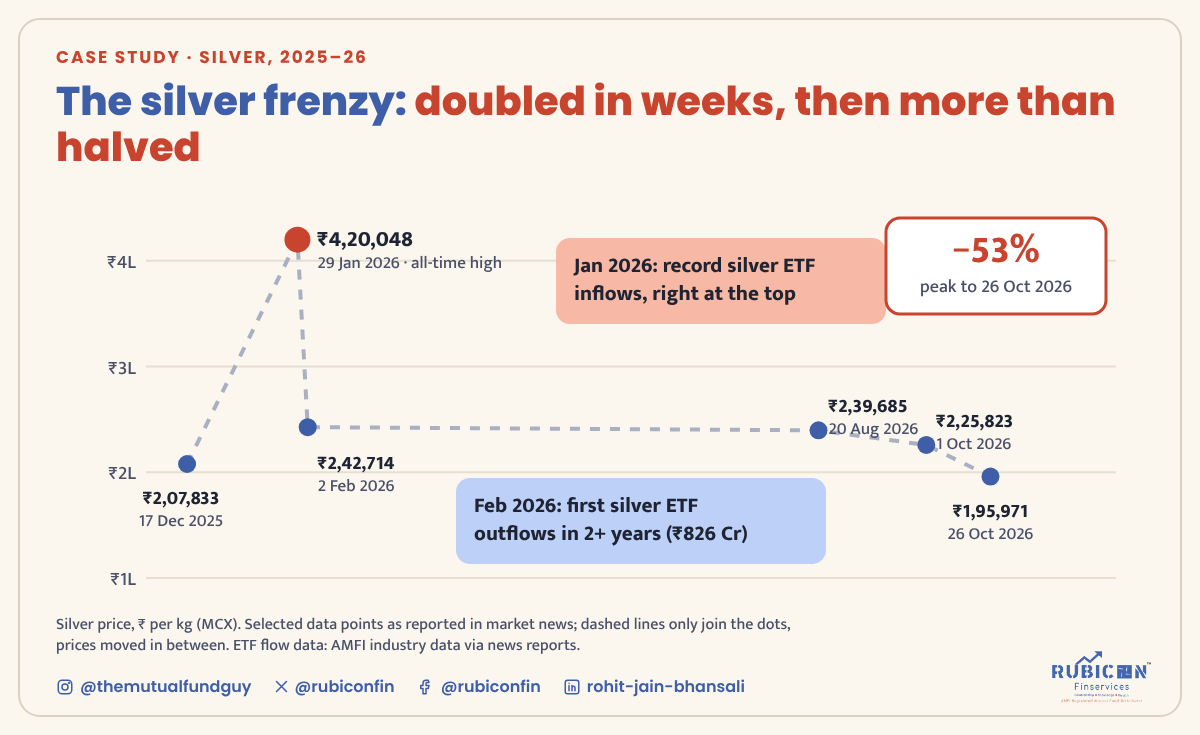
- In mid-December 2025, silver hit what was then a record of about ₹2,07,833 per kg on MCX.
- Barely six weeks later, on 29 January 2026, it touched an all-time high of ₹4,20,048 per kg. That is roughly double in a month and a half.
- Investors rushed in. Assets in silver ETFs grew more than 7.5 times between April 2025 and January 2026, and January 2026 saw record inflows, right at the top.
- Then the tide turned. Within days, silver fell to around ₹2.43 lakh per kg. In February 2026, silver ETFs saw their first monthly outflows in over two years (about ₹826 crore). Many investors who bought at the top sold after the fall.
- By late October 2026, silver was trading near ₹1.96 lakh per kg, more than 50% below its peak.
Notice the pattern. The heaviest buying happened when prices were highest, and selling began after prices had already fallen. That is herd mentality in action: buy high, sell low.
Gold went through a similar, if milder, cycle. A long rally drew in a wave of new investors, and prices then came off their highs. Gold and silver have a place in a diversified portfolio. The mistake is not owning them. The mistake is buying them in a hurry only because they have just run up.
Case study 2: Optimists at the top, pessimists at the bottom
The stock market follows the same script, just over different time frames.
When markets are rising, optimism is everywhere. New investors open accounts, SIP registrations climb, and stories of quick profits spread. When markets fall, the mood flips. The same investors who were confident at the top start stopping SIPs or redeeming at the bottom.
Remember March 2020. The Nifty 50 fell from about 12,360 in mid-January 2020 to about 7,610 on 23 March 2020, a fall of nearly 40% in around two months. Fear was at its peak and many investors exited. Yet by November 2020, the index was back above its January high. Those who sold in panic locked in their losses, and those who stayed invested, or kept their SIPs going, recovered and went on to benefit from the rally that followed.
This swing between greed and fear is often drawn as the cycle of investor emotions:
![The cycle of investor emotions from optimism and euphoria to fear, panic and relief]](https://rubiconfinservices.com/api/files/rubicon-finservices/blog/admin/360b3dd336db495f8a0fe29a9d32fcac.png)
The cruel irony: the point of maximum comfort (euphoria) is the point of maximum risk, and the point of maximum discomfort (panic) is often the point of maximum opportunity.
The real cost: buying high and selling low
Herd behaviour hurts in two ways. You put more money in when prices are expensive, and you stop, or pull out, when prices are cheap.
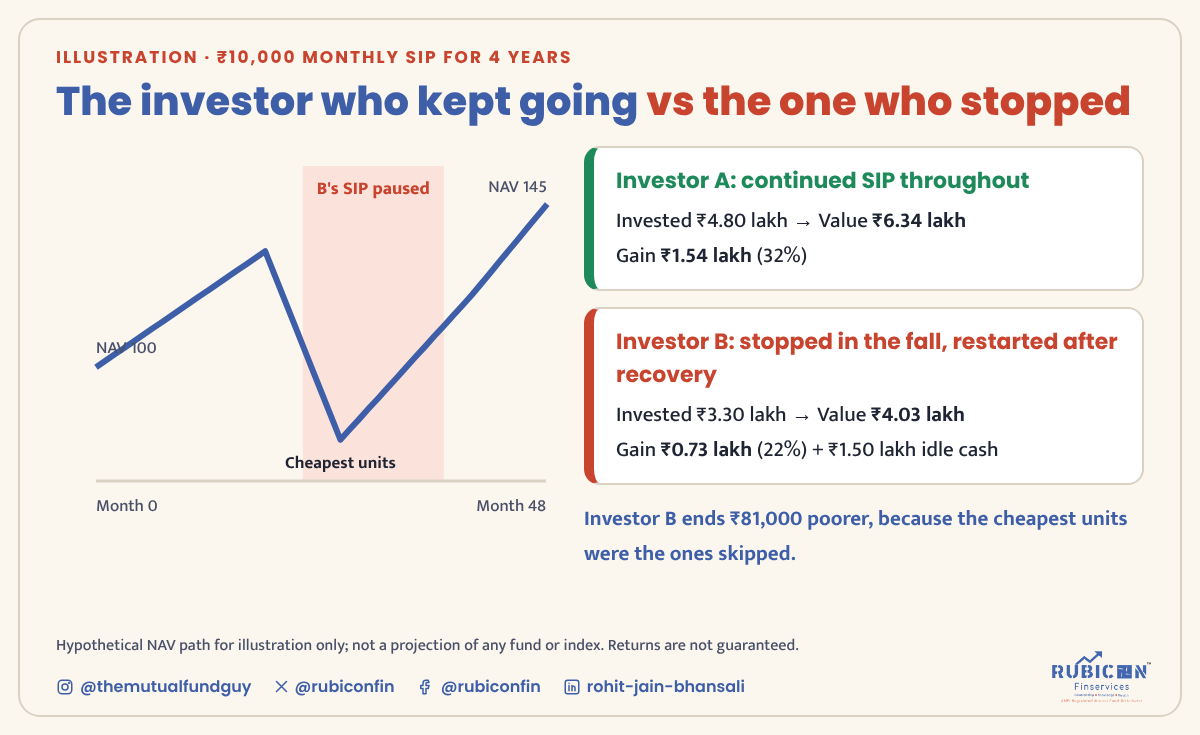
Here is a simple illustration. Two investors each start a ₹10,000 monthly SIP in the same fund. Over four years, the fund's NAV rises from 100 to 132, falls to 80, and then recovers to 145.
- 1Investor A keeps the SIP running throughout. Invested: ₹4.80 lakh. Final value: ₹6.34 lakh. Gain: ₹1.54 lakh (32%).
- 2Investor B gets nervous, stops the SIP once the NAV has fallen more than 15% from its peak, and restarts only after the market has clearly recovered. Invested: ₹3.30 lakh. Final value: ₹4.03 lakh. Gain: ₹0.73 lakh (22%), plus ₹1.50 lakh sitting idle in cash.
Investor B ends up about ₹81,000 poorer than Investor A. The reason is simple: the units Investor B skipped were the cheapest units of the entire four years.
(This is a hypothetical example for illustration only. It does not represent any fund or index, and actual returns will vary.)
The contrarian rule: invest when it is not the "best time" for that asset
If following the crowd leads to buying high, the answer is to think differently. Warren Buffett put it best:
"Be fearful when others are greedy, and greedy when others are fearful."
In practical terms:
- When an asset class is the talk of the town and has run up sharply, be cautious about adding fresh money, and consider booking some profit if it has grown beyond your planned share
- When an asset class is out of favour, the headlines are gloomy and investors are leaving, that is often a sensible time to add gradually, provided its long-term case still holds.
This does not mean blindly buying anything that has fallen. Some assets fall for good reasons. It means you should not let the crowd's mood decide your actions. A plan should decide them.
How to protect yourself from herd mentality
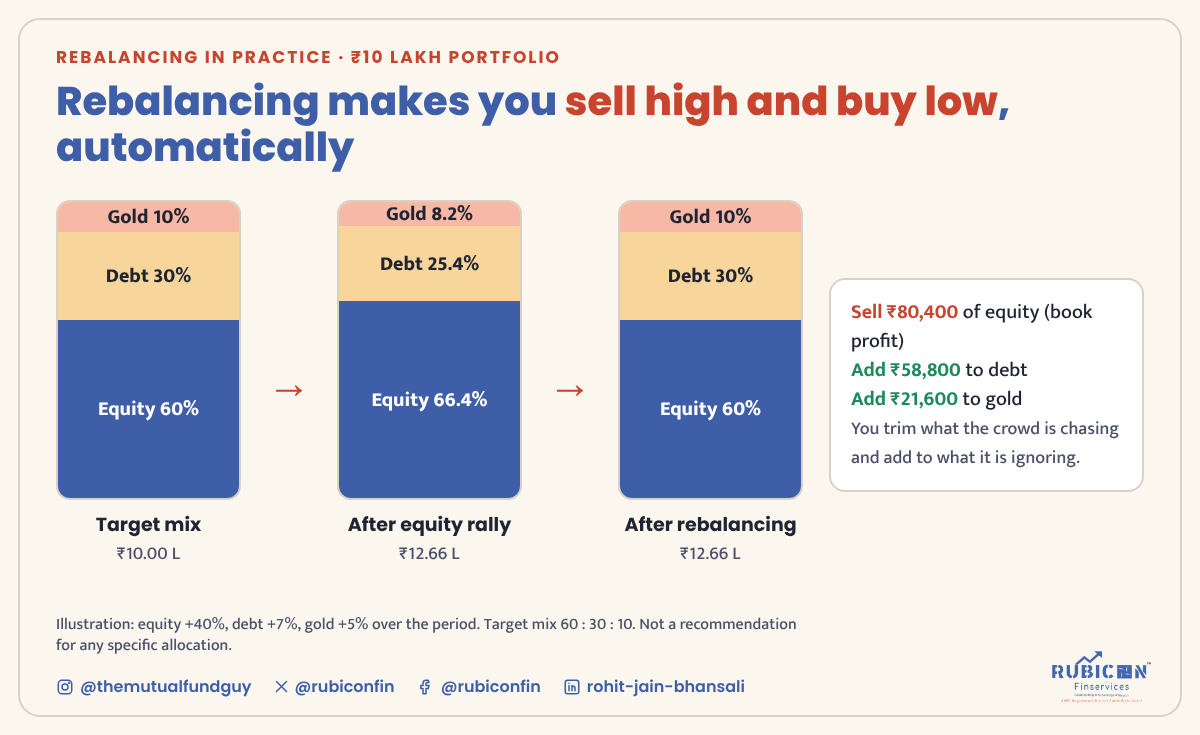
Take a ₹10 lakh portfolio with a 60 : 30 : 10 target in equity, debt and gold. If equity rises 40%, debt 7% and gold 5%, the portfolio grows to ₹12.66 lakh and equity drifts to about 66%. Rebalancing means selling about ₹80,400 of equity and adding ₹58,800 to debt and ₹21,600 to gold. Without any forecasting, you have sold some of what the crowd is chasing and bought some of what it is ignoring.
- 1Fix your asset allocation first Decide what share of your money goes into equity, debt and gold based on your goals, time horizon and risk appetite, not on last year's returns. A written allocation acts as an anchor when headlines get loud.
- 2Rebalance periodically Over time, a rally in one asset class pushes it above its target share. Rebalancing brings it back. That means trimming what has run up and adding to what has lagged.
- 3Keep your SIPs running, especially in falls A SIP buys more units when prices are low. Stopping it in a downturn defeats its very purpose. If anything, a market fall is when your SIP is doing its best work.
- 4Spread out large investments If you have a lump sum, a Systematic Transfer Plan (STP) lets you move it into equity gradually rather than betting everything at one level. This reduces the risk of investing at a peak.
- 5Turn down the noise Social media tips, WhatsApp forwards and "this stock will double" messages are the fuel of herd behaviour. Check your portfolio against your plan, not against your neighbour's.
- 6Work with an advisor who will say "not now" A good advisor's job is not only to tell you what to buy. It is also to stop you from buying the wrong thing at the wrong time, and to keep you invested when your instincts tell you to run.
A quick checklist before any "hot" investment
![Five questions to ask before following the crowd into an investment]](https://rubiconfinservices.com/api/files/rubicon-finservices/blog/admin/70a34c6b5f5a45cea085c65aa85b00d4.png)
- 1Why am I buying this now? Is it part of my plan, or because everyone is talking about it?
- 2Has it already run up sharply? A big recent rally means higher prices, not lower risk.
- 3What if it falls 30–50%? Could I stay calm and hold, or would I panic and sell?
- 4Does it fit my asset allocation? What share of my portfolio will it become after I buy?
- 5What is my time horizon? Money needed in the short term should not chase volatile assets.
If you cannot answer these comfortably, it is probably the crowd talking, not your plan.
Conclusion
Markets will always swing between greed and fear. Gold, silver, small caps, IPOs, there will always be a new "hot" idea. You cannot control the crowd, but you can control your response to it.
Don't follow the crowd. Follow a plan. Set your asset allocation, rebalance with discipline, keep your SIPs going through the ups and downs, and let time do the heavy lifting.
If you'd like a second opinion on whether your portfolio is built on a plan or on the latest trend, our team at Rubicon Finservices can help you review it.
Rohit Jain Bhansali,Founder,Rubicon Finservices
rjb@rubiconfinservices.com
- Don't follow the crowd. Follow a plan. Set your asset allocation, rebalance with discipline, keep your SIPs going through the ups and downs, and let time do the heavy lifting.
ARN 102867 | Initial Registration 09-June-2015 | Valid till 01-07-2027 | SIF Valid till 15-03-2029 | APRN Valid till 17-10-2027 | APMI: APMI-APRN01145 | MSME: UDYAM-WB-14-0192124 | Grievance Officer: Prem Prakash Bhansali, complaints@rubiconfinservices.com
Mutual Fund and Specialised Investment Fund investments are subject to market risks; read all scheme and investment strategy related documents carefully before investing. SIF investments carry higher risk, including the use of derivatives and short positions, and require a minimum investment of ₹10 lakh per PAN. Past performance is not indicative of future returns. Rubicon Finservices is an AMFI-registered Mutual Fund Distributor and receives commission from Asset Management Companies for the schemes and strategies it distributes. This article is for investor education only and is not investment advice or a recommendation of any specific scheme or strategy. Figures in the illustrations are indicative.